

A Bird's Nest
Symbolism and stuff

I was thinking whimsically about symbolism and stories, and all the variation you can put on an object for its possible meanings, and I was considering -- a bird’s nest.
So what does a bird’s nest mean?
It can mean all sorts of things. As always, the story decrees what it actually does mean.1
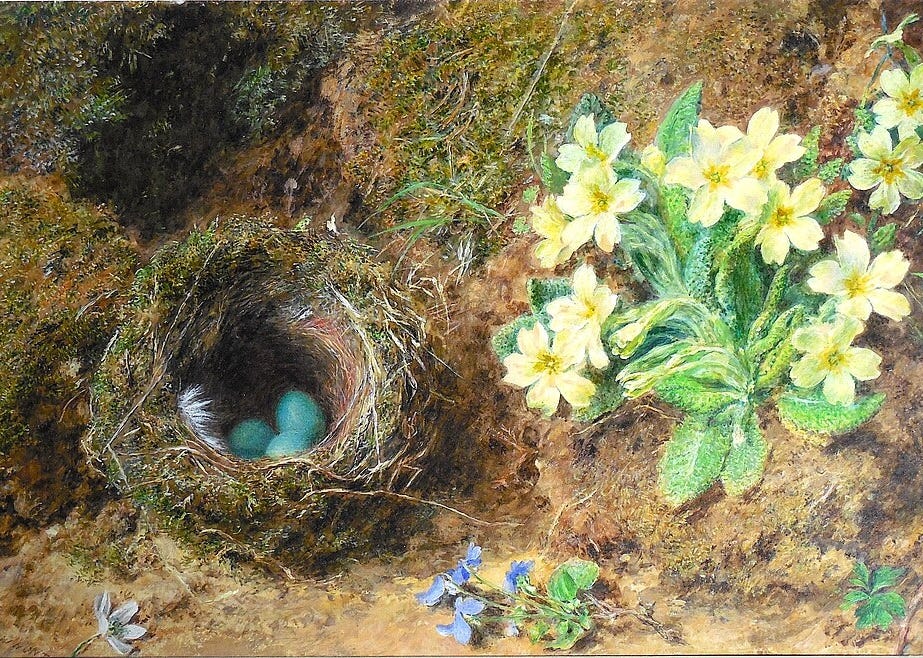
Some are easier to load onto it than others. For instance, it can mean home and security.
Which can be good for a viewpoint character settling down.
Bad for someone who feels trapped into settling down -- either in general or with the person he feels compelled to settle down with. The narration may agree with him, perhaps portraying the birds as, well, fatuous birdbrains, or disagree, portraying the birds’ joy and motion against the viewpoint character’s sullen mopping.
Conflicted for someone who longs to settle down and envies the bird. A straightforward envy, or perhaps with resentment for the way the birdbrains do not have to worry about a trouble that will be bad, even for the birds, or merely do not have their hearts broken.
In particular, the nest could be compared to a family house. As a place of security and warmth, to be sure. Or it could be scorned as a temporary makeshift, such that every year, all the birds have to rebuild their nests from scratch, as opposed to the centuries-old edifice that has provided for untold generations of the family.
On the other hand, the viewpoint character can view the nest as a prudent makeshift, to be discarded as needed, instead of the useless boondoggle hung about the neck of the latest generation, and indeed regarded as more important as the members of the latest generation, when they would be better off discarding it with as little thought as the birds and their nestlings would as soon as the young birds have fledged and can fly.
The nest could be a marvel of engineering -- though it might be wise to pick the bird with care, after careful inspection of how they build their nest.
Or a ramshackle mess. Which requires equally careful inspection. Thought, of course, it could be a symbol of the folly that dismisses the nest as such without realizing what artistry went into building up something so carefully out of mud and twigs.
Let the bird build in the wrong place, and the nest turns into a complete nuisance that the character has to deal with, and perhaps can not deal with until the nestlings fly off because people will have vapors over removing it before. Then it symbolizes all the unthinking interference that makes the character’s life so difficult.
It can be, more easily, a symbol of life, as the nestlings chirp with the spring blooming about them. With the birds making the nest up front to the fledglings spreading their wings.
With added elements of joy and play if, say, it’s outside a school, and the pupils eye it with envy as they plod through their studies.
Or perhaps a contrast between the birds’ unthinking and constant actions as opposed to the ascent of knowledge by the pupils.
Or perhaps as a parallel, so that the pupils’ triumph in their final test matches that of the nestlings as they fly off, abandoning the nest they outgrew as the pupils abandon their school, for the wide world.
On the other hand, it can work as a symbol of death. Sentimentally, as the birds abandoned it to decay, or philosophically, because of the abandonment, as a symbol of how all things wear out and end. Or with more of an edge, if something gets in and gets the eggs, or the chicks.
If the nest was built in the wrong place, the death may be a logical and indeed inevitable conclusion, thus making it also a symbol of folly and lack of judgment.
Any of these may turn on the viewpoint character. Or the narrator. The more the narrator is effaced, to become as characterless as possible, the more subtly the effect has to be suggested. With careful loading of adjectives. With characters expressing different views, some more wisely than others, or perhaps with the characters’ relative folly and wisdom having already been indicated.
But a bird nest can hatch a lot of possibilities.
One of the possible etymologies of "nasty" is from Dutch "nestig", nest-like, filthy as a used bird nest.
We went to see the Great Blue Herons nesting, and while extremely impressive they are also quite nestig--they are rather large birds and if you put 20-30 in one place, plus young, it generates a whole lot of guano. Someone put in a bench right there which no one is ever going to sit on....
And sometimes, it's just a nest. [Wink]