

Dark Dreams
Defining dystopia

How to tell whether a work is a dystopia --
A much more urgent matter than telling whether it’s a utopia, because there are so many more possibly dystopian stories.
Obviously, it’s a story that takes place somewhere bad.
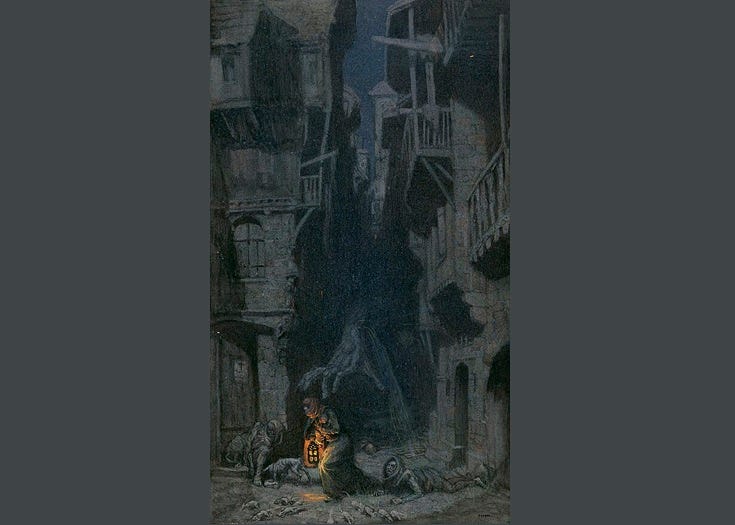
We can quickly dismiss the ill-conditioned souls who declare that Plato’s Republic dystopian because they don’t like it, or say that the drugged, unthinking drones of another dystopia like the setting, and so that can’t be dystopian. It is the story, not the reader, that decides whether it’s dystopian.1
It also needs to be something stemming from human intent in the current time. A pestilence-stricken city is horrible, but to qualify as dystopia, some character has to be doing something to make it worse. Infesting the victims. Exiling all the victims to this city and not providing for them. Taking advantage of this to cause the opponents of the city government to vanish. (Alien invasion is right out.)
I have seen post-apocalyptic stories called dystopian. This does not work. Whatever triggered the disaster need not even have been of human origin, and if it was, those responsible are not keeping the ensuing wasteland horrible. It does that on its own. Even if the desolation is filled with untrustworthy people who prefer robbery and cheating to building, and that is why society can not rebuild, this is not dystopia, because the criminals’ mere intent is to live off other people.
If people are seriously trying to rebuild a society, it can edge toward dystopia -- particularly if the criminals want to stop them because they will be harder to rob -- but only insofar as the dominant problem is malicious or arrogant intent. One problem is that rebuilding society has so many necessary steps where ill will does not matter. And because it is necessarily rural, it means that natural forces rather than human choices dictate a lot. It is generally not dystopian.
Neither is the impoverished life of a colony planet where the problem is the infrastructure is not up to producing more than the bare minimum to live, and all excess needs to be plowed back into infrastructure, or any accident will plunge them below the minimum.
To qualify as dystopian, there would have to be, say, a debt stemming from the colonization that they have to play come hell and high water, and the rate is extortionate.
Mind you, it can be a foolish and impossible set-up. If you work out the math, perhaps that horrible debt costs each individual settler less than a snack costs. But that is still is a dystopia, just a very foolishly built one.
Another factor is that this human choice and the resulting set-up has to be the story problem. I have heard cyberpunk called dystopian, but the thing about it -- what made it so shocking -- was that while SF had included many worse worlds than cyberpunk, in all of them, the protagonists (at least some of the time) regarded the world as something to be changed. In cyberpunk, the characters regard it as something to be navigated.
In that “at least some of the time”, to be sure, a great divide lies lurking.
At one extreme, there is the precautionary warning, the dystopia as an exemplar of what might happen. The hero perhaps learns how horrible it is, and at the end is defeated by it. 1984 as an example of the surveillance state. Brave New World about stupefying societies. Handmaiden’s Tale about a fundamentalist theocracy.
Now, all dystopias have a bit of the precautionary warning, merely because if a society is horrible, but can not be regarded as a warning, we do not call it dystopia.
If, say, you have a society based on Aztec culture, where there are relentless wars to take captives for human sacrifice; where children are taken from the populace to be sacrificed to the rain god, and it’s important to make them cry to ensure good rain; where children go through an initiation rite between the ages of two and five that involves total strangers taking them away, keeping them up all night, and forcing them to drink alcoholic beverages -- however horrible, unless the story implied an analogy between it and modern society, it would not be a dystopia.
You might still run across it in SF, because horrible societies make good opponents. This is the other extreme, where the dystopia is a foe. Sam Hall against the surveillance state. Fahrenheit 451 against stupefying societies. If This Goes On. . . against a fundamentalist theocracy.
The world-building in these tends to be better, because they are written by writers with an SF background. And the dystopia is vastly more likely to go down.
True, in Fahrenheit 451, what the Book People do is survive a war by removing themselves from the cities, but that is more than happens in Handmaiden’s Tale, where there is merely an appendix viewing it in retrospective.
I have read people who claimed that the overturn of the dystopia is new, citing Handmaiden’s Tale. Not at all! There is a very long history of overthrowing dystopias much more overtly.
Which is why this distinction is useful. It produces very different tales.
It would be a lot more useful if people didn’t blur the meaning of the original word, but all we can do is combat the tendency.
One problem with this is that I've seen societies and customs defended in both fiction and non-fiction that any sane person would describe as dystopian, or at least as desperately needing to be changed, defended as an earthly paradise. Like the anthropology book that defended the "deep and sincere spirituality" of cultures that engaged in human sacrifice. Including Australian Aborigines who, according to the author, forced women to kill and eat their first-born child to "return them to the ancestors".
There was only one religion he didn't like, because it kept interfering with all the deeply sincere and spiritual cultures he praised. I think you can guess what religion it was.
To me, the key aspect to the setting being a dystopia, is the characters being told that it is a Good Place with the readers seeing it as a Bad Place.
Obviously, "readers seeing it as a Bad Place" can be very subjective.
A traditional Muslim would see "Handmaiden’s Tale" very differently than most Americans would see it.