

Fantasy Foods
Eating in other lands

What can your characters eat?
Past price and sumptuary laws, past climate, past questions of harvest and crop failure -- what are the possibilities?
This can get -- complicated. Consider that the first edition of The Hobbit contained tomatoes, later expurgated, but that Tolkien never removed tatters, or pipeweed, merely veiling the New World potatoes and tobacco under new names.
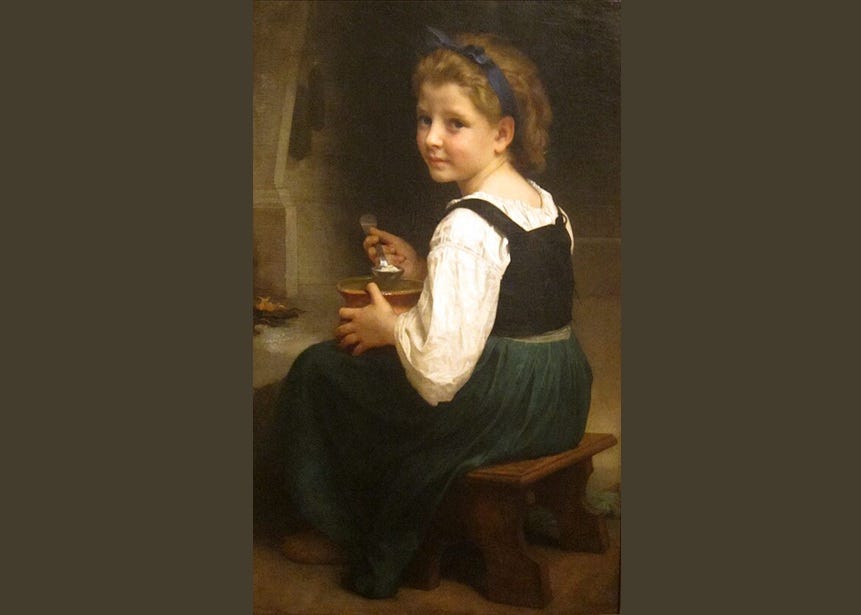
Part of this is, of course, that your readers will take the foods as an indicator of what society they are in. The more historically aware of them, of course -- you have to clue in the others as for flowers.1 But if you have coffee, many readers expect at least early modern.2 If you have a Christmas feast celebrated with the boar’s head and the wassailing bowl, they expect medieval. If you serve chocolate at all, modern, and if it is in solid candies, not even early modern. (The Hobbit is, of course, influenced by the way it juxtaposes a idyllic but modern English countryside, down to providing umbrellas, with a medieval culture, even Dark Ages in some respects.)
If the culture is not very modern, and lacks magitech,3 what foods they can eat depend also on transportation. Particularly fresh food. Some foods are seasonal.4 Others depend on a ship coming in. And still others, while technically known to your culture, still have to spread there, whether that’s imported or grown locally. Farmers, living in dread of famine, tend to be reluctant to adopt new crops, and people in general to buy new foods, especially since importation makes them very expensive. (Spices, being the most compact value and the easiest to preserve, tend to be the only thing traded far.)
In tension with this lies the history of your world. Does your world even have continents so far apart that agriculture could evolve for millennia down different paths? And what distance would mean they were that far apart if your wizards can fly? What if a ship that tried to sail toward the other side of your continent by going directly opposite would go over the edge?5
If you don’t go in depth on geography, you may be able to just deploy what food will back up your world-building by comparing it to a similar culture. But if you have tropical foods, such as pineapples, it implies not only trade with the tropics, but that a tropical region exists in your world. Which of those is the important implications turns on your world-building, of course.
On the other hand, the characters in the story are unlikely to think much about where the food comes from. If you simply choose the fare typical for an era, no one will ask why your steampunk characters drink coffee, tea, and hot chocolate while your medievalish character drink ale and beer.
One notes that most fantasy goes easy on the problems of feeding people, with the implied magic.6 Meat is far more common than it would have been historically. Places do not have a communal oven to handle the laborious and time-consuming task of baking before the invention of the perpetual oven -- that is, an oven where heat is continually applied, instead of the old-time ovens where you heated up the oven with a big fire, racked out the coals, and then put in batches of baked goods, timing them to take advantage of its cooling to bake different dishes.
It’s wise to keep any eye on that. Actually fantastical dishes, such as a haunch of yale, are difficult to introduce gracefully, and if you make roast phoenix or the like a commonplace dish, you risk make the phoenix a commonplace bird or the like. But if the characters sit down to breakfast of eggs and bacon, with coffee, there may be a danger of making the fantastical setting a commonplace one.
Sometimes a commonplace meal works. Sometimes it produces a cozy setting, and sometimes it produces a sharp clash with an attempt to walk to a neighbor ending up on the other side of town after you remember to turn your shirt inside out to break the pixy-leading.
Choosing your foods, so that they help the setting while (generally) remaining in the background, is more a matter of suggestion than showing. Choose wisely.

Coffee and Comfort

What could be more logical and sensible to introduce to your cozy fantasy than a coffeehouse?
Magical Technology

Any sufficient advanced magic is indistinguishable from technology. This is a very useful axiom if you wish your high fantasy to evade the downsides of history.
Spring, That Unpleasant Thing

Lovely season isn't it? It's getting warmer, and all the difficulty of getting firewood, or less pleasant fuels, is less important.

Magic, Reality, and Grinding Poverty

I have talked about using magic to elide the unpleasant aspects of your world.
In my fantasy campaign Tapestry, the player characters were seagoing merchants. They started out carrying smoked salmon to a city-state whose rivers didn't have salmon; they ended up exploring another continent and bringing back spices and chocolate. A significant share of the cargo was high-value foods. . . .
And here I thought just planning dinner menus for the family was complicated . . .