

Sew, Sew
Textile work in history and story

So your female character is sitting about. So -- what’s she doing?
That depends on how rich she is, though as a tendency, not a law. If she’s poor, she’s going to spin. And if she’s well-off, she’s going to sew.
Textile work -- barring the most strenuous -- was women’s work. And spinning was the most labor-intensive. Several women’s spinning was needed to supply one weaver with work. (With the unpleasant consequence that a merchant could pay out twice as much to have wool spun as to have it woven, but spinners still lived in penury.)
Consequently, women spun. A lot. Spinster was originally the term for a female spinner. Indeed, a woman using a spindle could spin while walking, and many did. (Spinning wheels were more efficient, but there was a lot of spinning to be done.)
As an added advantage, you could talk, or tell stories, or sing, while all the spinners spin. Providing both local color and an opportunity for your story.
On the other hand, that social class may not be suitable for your characters. Those of higher status are more likely to sew. Etiquette books can prescribe
If a lady, however, be engaged with light needlework, and none other is appropriate in the drawing-room, it may not be, under some circumstances, inconsistent with good breeding to quietly continue it during conversation, particularly if the visit be protracted, or the visitors be gentlemen.
Light needlework is important. At least for the social circles at which this advice was aimed. No matter how necessary their sewing was to the impoverished family circle, a family with pretensions to be gentry would have wives, sisters, daughters, grandmothers doing that work when there could be no guests.
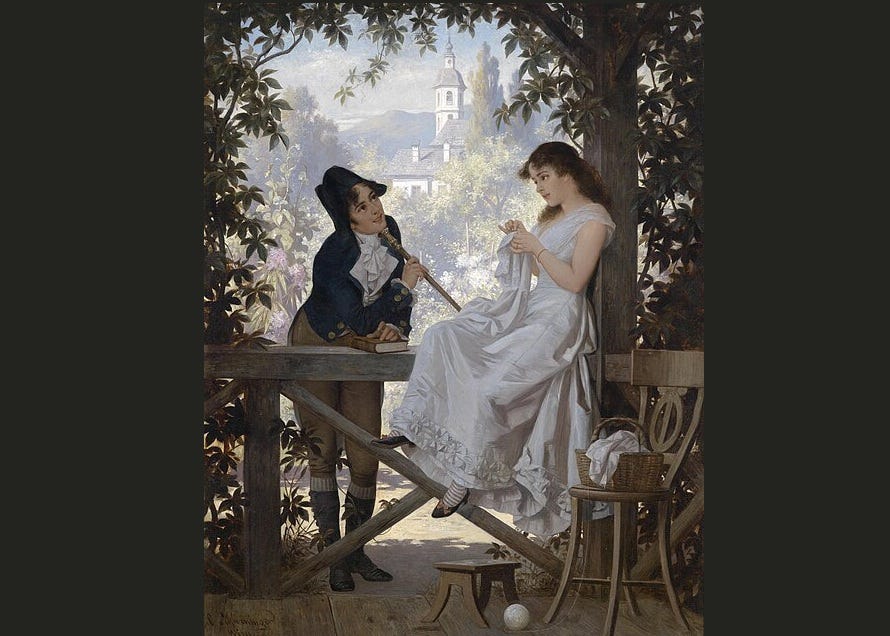
Middle-class women might do more practical work. Down to, in some eras, holding sewing bees where all the neighbors would come together to sew. And talk. Or sing. Or have someone read to them. Or even have someone come wooing.1
Then sewing does not just offer situations you can use. Sewing offers actual plot device use, if you detail what they are sewing. You don’t have to, if it’s just local color, but you can.
In the Odyssey, Helen give Telemachus gifts that she had sewed herself. Queens can engage in this sort of royal gift as an act of diplomacy.
I’ve never used it for that particular purpose, but I’ve used it for others.
In Madeleine And The Mists,2 Madeleine sews not only to pass time -- and quite a bit of time, because her rank means she is not significant -- but to prepare garments for when a baby is due.
In The Princess Seeks Her Fortune,3 Alissandra nobly sews for the local orphanage. In part so that she does not have to sew for her sisters, who scorn sewing. This is not something that would be treated trivially, historically. Even among princesses.
In Sylvie’s Escape,4 Sylvie sews to make herself useful, both in itself and to teach others some things she knows from court. And to hide. Every passer by would notice her if she did not work, and sewing is handy.
In Even After,5 sewing is routine -- punctuated by the events of the novel. When fairy tales are colliding endlessly with each other, both babies and the disenchanted arrive without wardrobes, and there are wedding gowns to be sewn, on top of the usual work. Snow White diplomatically explains that she was not so skilled in the needlework when the huntsman left her in the forest; she had a lot of practice, staying with the dwarves.
And then there is The Wolf And the Ward.6 It starts with Charity’s relying on her sewing to find herself a place other than begging on a roadside. And this turns out to be more significant than she knows.
At Amazon, Barnes & Noble, Kobo, Apple Books, Smashwords, and many other fine online venues!

At Amazon, Barnes & Noble, Kobo, Apple Books, Smashwords, and many other fine online venues!

At Amazon, Barnes & Noble, Everand, Smashwords, Apple Books, Kobo, and more!

At Amazon, Barnes & Noble, Kobo, Apple Books, Smashwords, and many other fine online venues!

At Amazon, Barnes & Noble, Kobo, Apple Books, Smashwords, and many other fine online venues!

Spinning and weaving and sewing - ever since I read about a quilt pattern from the Ozarks that was supposed to keep witches off of someone as they slept, I wondered about someone inventing a quilt pattern that works as the reinforcement of a binding spell to keep some ghastly horror confined. It works as the women of this particular valley sew it again and again, teaching it to their daughters and granddaughters. Until the custom, and pattern, dies out, and the binding starts to weaken...
Actually, all women, of all classes, would spin and weave, and sew. (How do I know this? There are pictures of richly dressed women gathered together with their distaffs and spindles.) It's just that *what* they spun would be different. Poor women would spin rougher wool and coarser linen; wealthy women could afford the better-quality wool from the best breeds of sheep, and linen that had been heckled almost as fine as silk. (Silk-spinning, of course, was exclusive to places where the silkworms grew, which was China for most of history.)
It was often the designated job of the second daughter to exclusively spin, both to provide for the household and to sell excess yarn, while the other women would do the weaving, knitting, and sewing to keep the household clothed. This probably explains the number of stories where the daughter hates spinning and finds some way to escape the task.