
Slow Motion
Applying history to story

Travel is hard.
I mean, it is really, really, really hard. Roads are terrible. If they exist. Bridges fall down, or get flooded out, or simply do not exist. Crossroads may bear no markings, and so your choice may be life or death, with no knowledge, and you may not learn you went the wrong route for days, weeks, even months later.
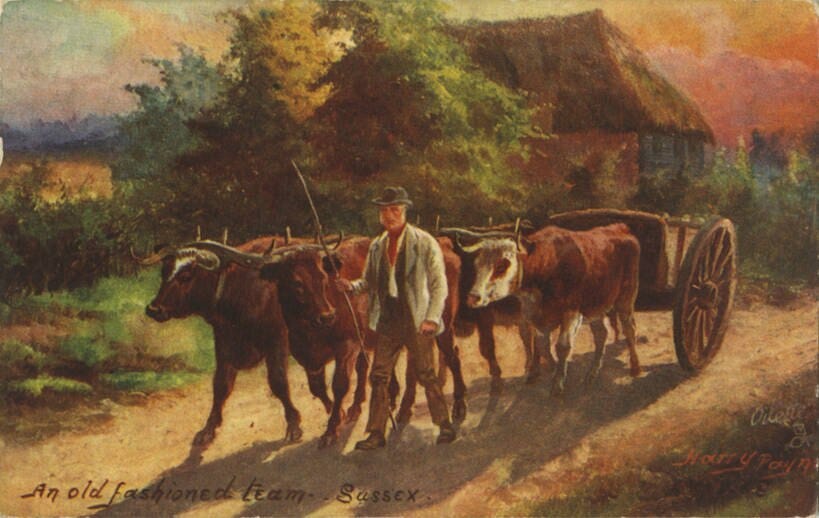
Your speed is limited to your own plodding feet, or perhaps a beast that can carry you, but if you go by beast, you may not go much more swiftly because the beast needs rest and food and is incapable of traveling relentlessly all day. (The swiftest travel requires relays of horses. Or runners, but that will work only for messages.)
Not to mention the adventures dealing with war, or royal officials, or bandits, or just suspicious residents.
Land travel is difficult enough that traveling by sea is better, even with all the problems of waiting for winds, storms, becalming, rations, water, and shipwreck.
The consequence of this is that whenever someone travels, his family and friends lose contact with him.
One particularly eerie aspect of the banshee was that when she keened for the death of someone in your family, you might not hear for many months of the death that happened the next day.
Even mundane tales are rife with such things as brothers and sisters failing to recognize each other because they had been so long parted. (No doubt helped by the way that the age gaps could be much larger, since historically, couples went on producing children as long as they could be conceived.)
And yet I stare at the page and wonder whether the story as plotted works.
The heroine does indeed live at her parents’ estates, in the mountains, in the borderlands -- at any rate, some out-of-the-way corner where few travelers go.
She does indeed go on a pilgrimage, and if it’s not the extent of, say, one from Norway to Rome, I could certainly make it leave the kingdom.
Then she gets involved in politics. And politics that have gotten violent, over the succession. And once they have gotten violent, they can’t back down.
Perhaps I shall make the border regions fall under the control of the other faction -- her involvement having forced her onto one side.
And the prince leading the faction she’s in is reluctant to send a messenger into dangerous lands for reasons that will not benefit him in his fight.
So I look at this pile of reasons and wonder whether I should pile it higher, or perhaps work harder on explicating it for the benefit of the readers to whom this is all strange and alien.
Because after she goes on this pilgrimage, she returns home with a husband and two children in tow. Year-old, twin children, but children. And they had never met her husband before. She had never met her husband before she entered the prince’s service. It took her at least several months after falling in with the prince to get married.
Can you really convey that no news came back about their daughter until she showed up?
All right. Deep breath. And fall back.
What is needed is foreshadowing.
And what that needs is for her to not be the only fish in the ocean.
People are gone for long times. News is scarce. Perhaps the hills in which she lives are particularly derided for their lack of news.
Perhaps I can rip off the Peach Blossom Spring tale. Actually having a valley in which people are unaware that they aren’t still in the reign of a long-dead king would be overkill. But someone could tell it.
On the other hand, if I do that, it’s probably going to have to be significant in the struggles. Both factions need to have serious troubles about knowledge. (All the more in that, for another reason, the heroine has reliable knowledge that she can’t justify.)
Not to mention all the world-building effects. Only on rivers or other bodies of water is any real degree of famine relief possible. Control of the borders of even your kingdom is precarious. Your emissaries have to have real authority because they can’t check with you.
Writing is full of these things. You start with a scene you want, and you end up dictating the world-building all over.
Thanks for this reminder post on how slow travel in pre-modern times could be. I especially like the comments about the banshee. I remember a book by late Victorian ghost-hunter Elliott O'Donnell where he commented on how his family's banshee once put in an appearance when he was a boy. It cried and wailed all night long. He said his mother and aunt were convinced that a sickly relative of theirs was dead. The next day they learn that she's fine, leaving them confused. It took months before they learned that Elliott's father, a missionary in foreign lands, had been killed on that night. And that was the late 19th century.
The bits about travel time also put me in mind of one story from the Xanadu series where the Empress goes to visit a strong ally of her empire. Given that her empire was a bit shaky, being only about a generation old, and word got back about her ship being sunk (she lived and eventually made it back home), and how long it would take for word to get around, I have to wonder how much of an empire she had left when she returned!