

That Evil Magic, Part III
And stuff

So why does that Evil Religion hate all those wonderful people who practice magic?
Especially since they are merely using the hidden properties of natural things, not conjuring spirits?1
Even though they are carefully policing themselves to ensure they do so for good purposes, or at least innocuous ones?2
Still -- even past that hurdle, if the effect is real, and innocent -- are the means?
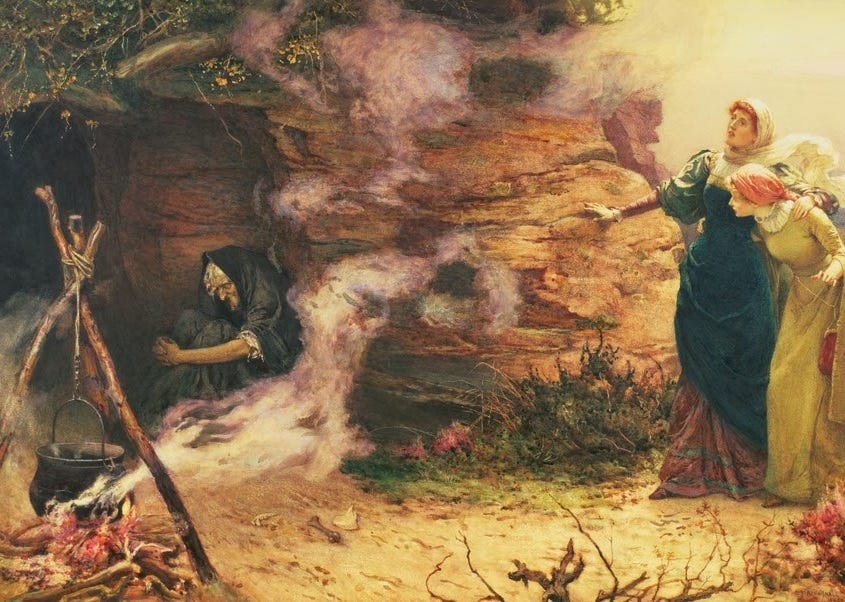
Does the wizard use graveyard dust, or worse?
Does the wizard have to commit murder to be initiated into the secrets of magic?
Does it matter if the intent is something so beneficial as breaking an evil curse if the spell involves stealing a bone from a graveyard?
We have ancient Roman manuals on how to make magical lead tablets that recommend using the lead pipes of the water system. Now, lead was an easily obtained material, you did not need advice on how to find it.
It is possible that the pipe’s being cold, wet, and underground was thought to contribute to the spell.
On the other hand, it is also possible that causing damage to the water supply was thought to contribute to the spell. Even to spells to bind a thief until he returned stolen goods, or bind someone to prevent harming another, as well as those to compel someone to fall in love. Or spells to bind someone in a court case, intended to prevent, instead of cause, injustice.
Perhaps binding spells are inherently evil, regardless of purity of intent.
This could get interesting if, in magic as in technology, it is the dose that makes the poison. If people know that foxglove is poisonous, it gets interesting when the wizard uses it to treat the heart. But that’s just the necessity of knowledge. Also, wizards do not have to use things that are dangerous in large doses.
An added effect may lay in the religion regarding some uses as sacrilegious. To use water from the holy well, lead stolen from the church, flowers set out at a festival is to profane what was offered. (And indeed, those who, historically, tried to invoke devils often used sacrilege as a means.) Especially if the religion teaches that such profane uses remove the blessing in themselves. And logically, a blessing’s effect would be to shift to theurgia. (They might get somewhere by arguing that blessing removes the devils’ ability to hinder the magic.)
If, in fact, the local wizard uses a perfectly circular and secular golden bowl, and a spring where he can draw pure water at dawn -- either also secular or else with the special blessing for this purpose, not because it’s needed but because they wish to pray for its success -- to conjure the sunny weather to let the haying proceed without rain ruining the harvest -- at a reasonable price -- things will be clearer. Somewhat.
The most obvious issue is that nothing prevents one wizard from working with both good and evil things. He conjures fair weather for the haying with a golden bowl, and then goes off to ensure the lord renders just judgment in secret, using the bones he stole from the graveyard.
Indeed, that has generally been the particular horror of magic -- or poison -- as opposed to straight-forward violence. The wizard can work in secret, up to and including making his foe fall over dead with no one being the wiser, even, that the man was murdered, let alone by which wizard and for which motive.
Well, nothing prevents it unless you set it up to be prevented. License the wizards. Control the supply of stuff. Prohibit the use of illicitly obtained materials, trace its procurement, track down the dealers, locate the buyers. Determine how to detect magic and trace it to the wizard. Devise ways to control the wizards who defy the law.
In one Lord Darcy story, an apparently upright wizard is revealed to have graveyard dust and like things in his possession, which no one should have without a special, research license. Thus he is under arrest. (One notes that the series has many laments about ill-educated souls who seek out the workers of dark magic in the ill-founded belief that it is more effective.)
On the other hand, in the Lord Darcy universe, the talent to do magic is innate,3 but it requires a lot of stuff. There is an amusing scene where Master Sean discusses his sharp silver knife -- honed to a fine edge, and then never ever used to cut anything, which would blunt that edge. Another character asks why he bothered with the sharp edge, and Master Sean carefully explains that he uses it as a symbol of a sharp knife. He has another, dull knife to use as the symbol of a dull knife, because the best symbol of a thing is itself.
This is atypical. Many fantasy works have no necessary stuff. In Harry Potter, we have, of course, Potions, but otherwise the magic is effected by words and wands. Gandalf has nothing but his staff on his journeys. Other fantasies don’t even need wands.
Perhaps that would have some effect? Particularly if, after the manner of Lord Darcy, the magic is simply something innate in the wizard characters?
More here.