110% this. I once wrote an article long ago on impishidea about it too. Build your worlds off what you're good at and interested in.
i.e.
For me, I often get lost imagining the biology of how peoples would be and the cultures that would arise from these realities. Like a people with poor eyesight but sensitive ears would highly value music but not as much paintings.
You also need to weigh simplicity of reading against depth of worldbuilding. My partner and I just finished Katherine Addison's _The Tomb of Dragons_, which goes heavy on the invented vocabulary. She does it well, I think, but it was still sometimes hard to read, and there's one word (the one for the undead dragon) which is such a long compound word, and shares so many elements with other words in the story, that it's just "the long r-word about dragons" in my mind. I think I was figuring it out from context every single time, and it slowed me down and made things harder. I also struggled with the titles of nobility, important though they are.


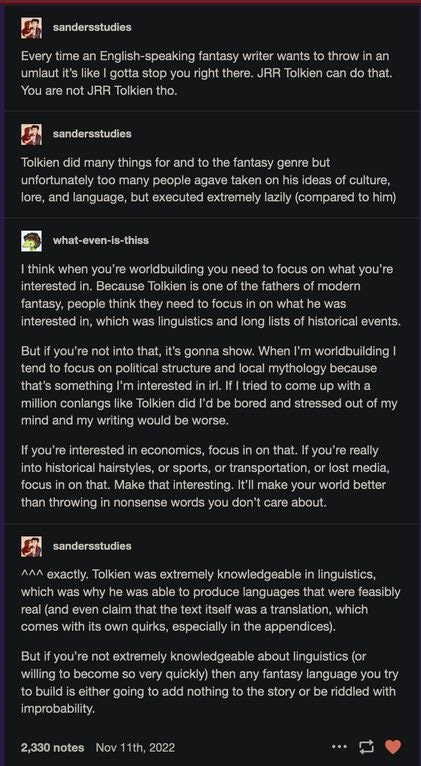
110% this. I once wrote an article long ago on impishidea about it too. Build your worlds off what you're good at and interested in.
i.e.
For me, I often get lost imagining the biology of how peoples would be and the cultures that would arise from these realities. Like a people with poor eyesight but sensitive ears would highly value music but not as much paintings.
You also need to weigh simplicity of reading against depth of worldbuilding. My partner and I just finished Katherine Addison's _The Tomb of Dragons_, which goes heavy on the invented vocabulary. She does it well, I think, but it was still sometimes hard to read, and there's one word (the one for the undead dragon) which is such a long compound word, and shares so many elements with other words in the story, that it's just "the long r-word about dragons" in my mind. I think I was figuring it out from context every single time, and it slowed me down and made things harder. I also struggled with the titles of nobility, important though they are.