

With Another Man's Pen
The continuing story

Ah, telling a story about another writer’s characters in that writer’s world.
I’m not talking about a plot that gets redone by many hands and presumed to have no connection to any other retelling. There are many, many, many tales of sleeping princesses. You can tell your own freely if you don’t point it to a specific one.
Neither am I talking about Matters where so many pens have gotten involved -- not to say have muddled up everything -- that many contradictory things have been added, and the core of what the characters has very few required traits, indeed.
You may wince at a historical fiction purporting to depict the True History behind King Arthur, and how it explains Lancelot, Galahad, and Tristan -- because you know all three of those were added to the Matter long after any historical events were lost in the myth -- but, after all, those who introduced them first claimed they were then in the history.
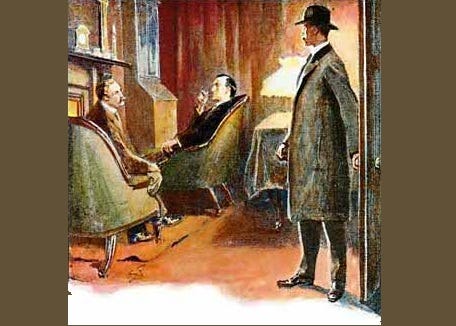
Rather, I’m thinking about a story sufficiently defined that central core is defined by a single writer’s handiwork. There can be flaws and inconsistencies in a body of work -- consider Sherlock Holmes.
Better, consider Oz. L. Frank Baum did not keep it consistent for the length of two books. Nevertheless, what Baum wrote is Oz, in a way that every well-regulated mind can agree that other writers’ work is not.
Furthermore, I’m not thinking of taking the tale, or elements of it, and pulling it loose enough that it stands entirely on its own as a work of art, without being even a deconstruction or a satire of the original work.
No, let us talk of a tale -- anything from a deconstruction to a fanfic -- that purports to be in the very world the original story is written in.
One thing that you need to think about is style. More or less depending on what is the original.
Oz does not have high style requirements for its world because it was written in a workmanlike style, and in the third person. You could not get away with a fancy or poetic style unless you carefully set it up, but a good plain style suffices.
Ripping off Shakespeare is more dangerous. You do not actually have to write in a Shakespearean style. You do not have to make your dialog all iambic pentameter -- though doing so certainly did not hurt Poul Anderson’s A Midsummer Tempest. But artful use of poetic language doesn’t hurt, and you want to avoid a voice that smacks of informality and the modern day.
Also, Sherlock Holmes. This is for a different reason. Those stories were almost all told in Watson’s voice. This was not a very distinctive style, but it was a voice, and the reader expects closer adherence than in other situations. Even subtle lapses, therefore, strike a discord. (Not to say that all writers who feign Watson’s voice fail subtly.)
And if you change voices, well, it takes considerable art to get into the true Holmesian spirit from another pair of eyes.
In particular, if you want a character as smart as Holmes, remember that everyone thinks the stories with Holmes as a narrator are inferior. He’s more impressive viewed from the outside, since we don’t see the false starts and the troubles in coming to his brilliant conclusions. This applies to any character as smart as he is, too.
Closely related to this is the issue of accuracy. One of the commonest uses of a different viewpoint is to assert that the original viewpoint got something wrong.
Sometimes this works.
Sometimes the original viewpoint character was depicted in the original work such that he would have, or could have, gotten something wrong, or missed something that would change the complexion of things. Or even lied. Ozma can gravely explain that L. Frank Baum, who openly described himself as telling stories of Oz, was, after all, telling them for children, thus explaining omissions.
(Though it would be amusing to see a retelling where a character claims to reveal the true story behind the hero, only to betray himself as an unreliable narrator, show the truthfulness of the original tales, and unwittingly depict the hero’s heroism in more dazzling colors. That would take masterly writing skills.)
But unless you can point to evidence in the original work that supports this gap between what that work says, and what yours says, you have introduced an aesthetic flaw into your work by putting in an incongruity. Especially if you are claiming to deconstruct the original work. You can not alter the work and show how it is flawed at the same time.
If you want to make alterations, you should boldly go forth, stealing the idea entirely, and write it up as your own, original idea.1 Then you get to set the parameters. You can even tell people that this is how the situation in that work would work in reality.
If you claim to be writing in the original story world, on the other hand, you need to accept its constraints as much as if it were an earlier work of yours in a series.2 The original story world still has the right to be viewed as a single work of art,3 and yours must add to it, or depart from it.
Stealing Ideas

Ripping off other people's stories is a classic way to get ideas for original fiction. This is not rewriting a tale -- which is quite feasible for public domain things -- but sometimes you just want to steal an idea from another work, even a public domain one.
Series And The Wreck

There's one particular problem with a series that does not turn on its length. It's the problem that it's not written as a whole.
