

Young Heads On Young Shoulders
Genre and viewpoint

It’s notorious that your story is going to be regarded -- by most people -- as being for readers the same age as your viewpoint character, or slightly older. So, a child protagonist for children’s books, and an adult for adult’s.
This is somewhat limiting.
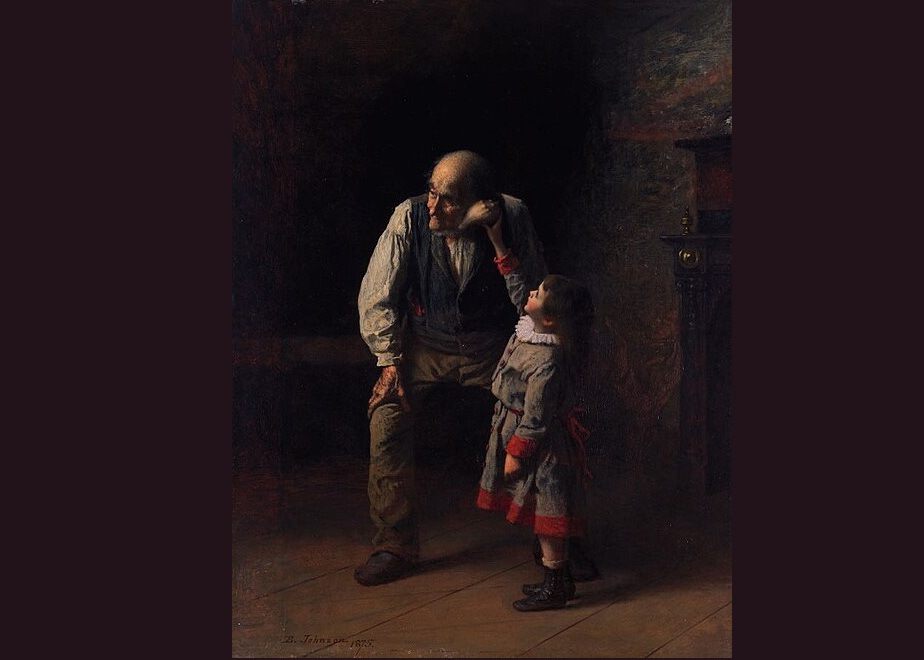
Still, the same-age protagonist does have some definite advantages. Particularly if the viewpoint is tight, and the character sees nothing, deduces nothing, thinks nothing, and feels nothing that is out of the character’s usual range.
And uses no language out of it, either. Perhaps that’s the most important one, or at least the most useful one.
If you want to limit your vocabulary and the complexity of your grammatical structures, to fit the genre, nothing beats doubling up the marketing necessity with making it a picture of your viewpoint character, thus aesthetically working with the limit.
This is the classic question of viewpoint, with a special constraint. That the story is told from the viewpoint of an unusual character is part of the charm of an adult story -- in part because the adult has read so many stories that such displacement makes it less simple. From a child’s viewpoint, it’s additional bafflement.
On the other hand, no important part of the plot can be omitted because it goes over the narrator’s head. Then, a children’s story should not have a plot where important elements go over the readers’ head.
Using an adult requires artificial limitations to keep the story within the genre for children’s books. It can easily form aesthetic flaws, though perhaps only the adult readers can fully catch them. It can be done, but the viewpoint only works when distant. Often enough a writer wisely splits off the viewpoint character to a kid sidekick while the adult hero does the protagonist part.
By the time the readers reach adolescence, you have more leeway with the plot. Indeed, one of the arbitrary (and silly) restrictions nowadays is not allowing YA to have an actual, if young, adult narrator. We had them in the juveniles of my juvenile years.
Younger narrators for adolescents founder on the natural desire of youngsters to grow up, and certainly not to retrogress. Which is not an aesthetic concern as such, but which is unlikely to change.
On the other hand, using a young character viewpoint for an adult story can added a piquancy that no other technique does.
Depending on the story, it can also give a clearer view of the events because some stories turn on every adult having an agenda and letting it becloud his thoughts. The child, having no ax to grind, and having no motive or ability to interpret what happened, can report it more lucidly, without misinterpretation except through inexperience.
Such a narrator does mean that the complications have to be implied, not stated, except perhaps in dialog that goes over the narrator’s head, much to the narrator’s disgust. (Even that technique needs to be handled lightly, because it is the narrator’s story.)
Though, to be sure, you want to be careful to reason out how much your viewpoint child could know, or figure out. Unfortunately there is no escape from ill-conditioned souls who insist that a child on the verge of kindergarten should still use “Me” as the sole first person pronoun, and more subtle errors in child development. Many are precocious for obvious benefits. Still, it’s wise to keep it within some bounds, since too adult a child defeats the purpose of having a child’s viewpoint. Some complications must be inferred, merely to keep from undermining that.
Then, of course, complications have to be inferred in a narrative told from an adult viewpoint with an ax to grind. who would logically bias the facts. It’s a matter of what there is to figure out, not whether.
The effects differ, and so the choice of narrator depends on the effect desired. Does the child’s clarity and ignorance do better than any adult’s obscurity and knowledge? Or perhaps a mix of viewpoint characters?
Good thing that it’s meant for adults with the judgment to puzzle it out.