

Always Greener
Idioms and other adventures

Why is the grass always greener on the other side of the fence?
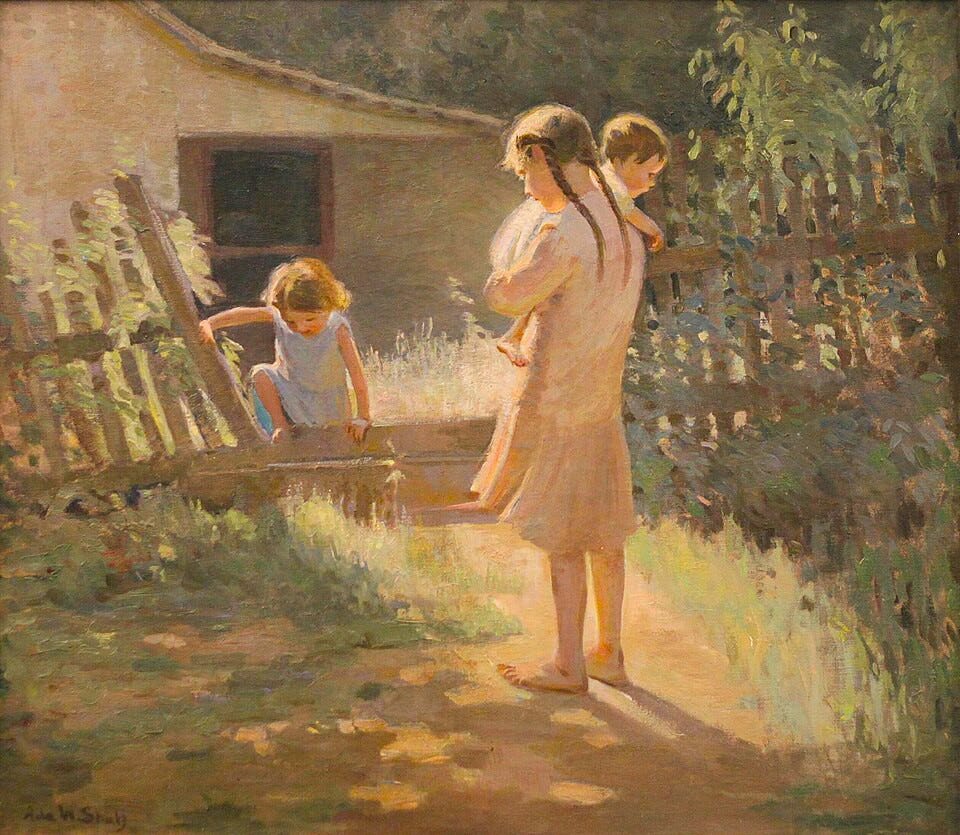
Why, because in pasture, the green grass is generally taller than anything else in the field. Consequently, when viewed from the side, it can veil the problems, the dead patches, the bare earth, and all the rest. Consequently, looking out over pasture will make it greener than yours, where you can look straight down.
A subtler effect than avoiding metaphors that your characters would not know -- such as “strong suit” when they do not know the game of bridge1 -- lies in dealing with idioms that were not dead metaphors in sort of culture that your characters lived in.
If you have shepherds in your story, the comment about the grass being greener is a metaphor using something they have all seen -- and if the shepherdess Phyllis retorts that actually, some pasture obviously look worse than the one on the other side of the fence, that can also happen.
Or consider -- brooding.
Naturally, the behavior of Byronic heroes, right? Gloomy, sullen, moody, arrogant, withdrawn, defiant, magnetic, scornful, implacable in revenge, brooding over his tragic past.
At the time this metaphor was devised, just about everyone would have been familiar with the original: the broody hen. Prone to fluff herself up to make herself look larger and peck at people who came too close.
The image was not that the attitude was similar. It was the way the Byronic hero would not let past injuries go. He would brood over them -- having drawn back, like the hen to her nest -- until they hatched in his revenge. You get the same effect as when he nurses his injuries, keeping them strong and not letting them die.
But if most readers think of the Byronic hero mythos when “brooding” is mentioned, in settings where there is any kind of hen-keeping, most characters would think of the hatching aspect.
Another one is lousy. Throughout most of history, this term, or the local equivalent, was used literally. Useful to have a term to indicate someone was lice-ridden, although (to tell the truth) that was normal. (Some places, people even regarded it as a danger sign that you couldn’t support lice.)
Nowadays, it is so thoroughly detached that you can surprise people by alluding to its past, and has even changed from the S-sound of louse to the Z of lousy.
Giving people “short shrift” is a dead idiom nowadays, but it no doubt felt different when executions were commonplace, and oftentimes the priest had to shrive the condemned in a short time. All the more in that the final confession was of grave significance to you as well as to everyone around you.
And being “nobody’s fool” had more punch in the days when some characters could say, “I’m the King’s fool, not yours.”
Hmmm. Or other characters could say, “The King’s fool lives at the castle, and isn’t yours, anyway.”
It take delicate handling to bring to bear the full force. If, that is, it can be done at all.
Evasive action may be wiser. Say that another man’s ducks are always plumper. Say that the Byronic hero hoards his injuries. Say that an article of clothing is shoddy -- or lice-ridden, as appropriate.
And so on.
It can take real effort to dig down to realistic figures of speech. Remember that the characters will always refer to things they find typical, and in an era with little travel, merely hearing of deserts, or arctic conditions, or what have you will not make it natural to speak of something being like water in the desert, or being snowed in. A character from a port might speak of a sailor who spots land after a storm, or being becalmed; an inland character, like rain after a drought, or being flooded.
It requires a stretch to avoid suggesting that the character are not modern, but the effort makes it clear that your world is different.
Sideways Advice On Style

Style is one of the less important selling points for a story. The plot, the characters, the setting need to be good, but people do not buy stories because they are well-written. Still, I seldom read published work nowadays where the style isn't at least competent and workmanlike, so some style needs to be developed.
Excellent points. It's something I look for when I'm editing and (although more difficult) when I'm writing my own stories. Thank you for sharing!
As my wife, Destroyer of Cliches, might have said, the grass is always greener in the kale smoothie.