
Libraries in Books
And their purpose

Every now and again, there’s an online discussion about which is your favorite library in a work of fiction.
Every time it comes up, I answer the same: my favorite library is the one in Robin McKinley’s Beauty.
This is because every library in a book is a plot device, and in Beauty, it has the rare use of having pleasure reading that facilitates the two main characters getting to know each other.
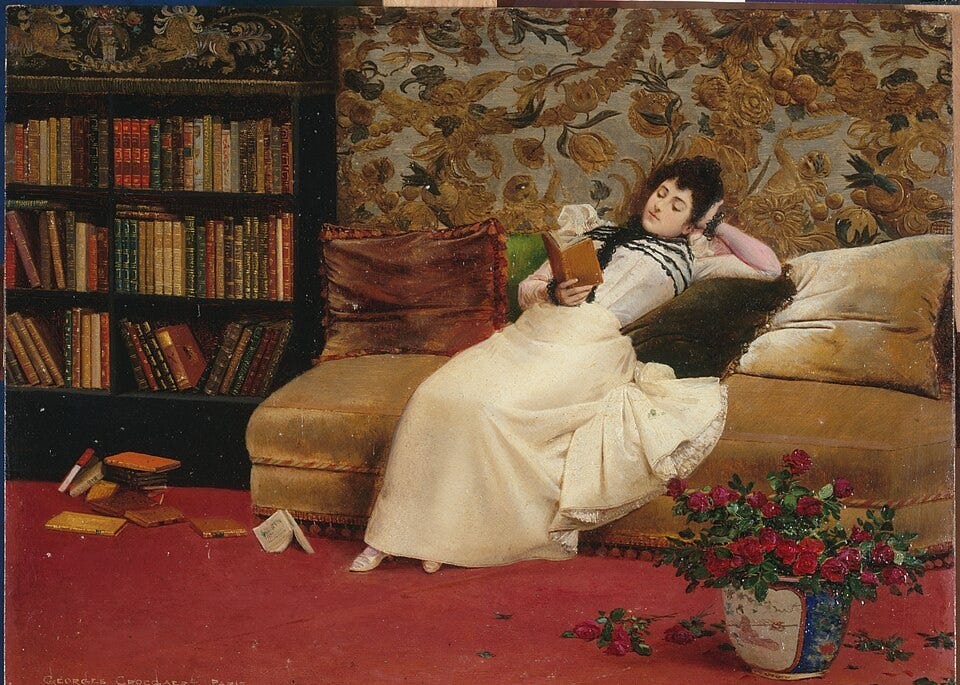
The vast majority of fictional libraries are there for research purposes.
I have a fair number of libraries myself. And they all serve to forward the story.
The Lion and the Library1 has the library itself front and center, because Lina is desperately looking for the knowledge to deal with the king and save her beloved.
The Book of Bone2 has Avice visiting a library as an episode in the story, but she’s looking for knowledge, not amusement. Plus, there’s a curse on the library to complicate her life, which might also interfere with pleasure reading.
Spells in Secret3 has a complication in that Kenneth and his companions are, indeed, trying to study spellcraft while in hiding. The problem is that while the locations they go to have libraries, none of them are designed to teach spellcraft at the level they need. The assumption being that all wizards who go to these places have already completed all the basic studies and, anyway, can go and fetch books if any are needed.
They do derive both knowledge and amusement from the libraries -- especially knowledge of things that are not routinely taught -- but more frustration because they need that basic knowledge first.
A Diabolical Bargain4 has two significant libraries, and in either one, Nick is looking for something to study. In the university library, others are also looking for it. Though, as the title may warn you, they may also find books that were planted for them.
On the other hand, it also joins hands with Beauty in one respect. The pleasure reading helps Beauty and the Beast because they share which books are good reads, discuss the art of reading the enchanted library (not all the books in it have been written yet), and read to each other.
Nick talks about his studies with the other scholars, sometimes brushing on what he read. More important, he tells stories.
Characters telling each other stories do not have do so from memory, if that would fit your story better. A scene in which your characters read to each other makes your pleasure library a plot device, and fits into the world and the story.
At Amazon, Barnes & Noble, Kobo, Apple Books, Smashwords, and many other fine online venues!

At Amazon, Barnes & Noble, Kobo, Apple Books, Smashwords, and many other fine online venues!

At Amazon, Barnes & Noble, Kobo, Apple Books, Smashwords, and many other fine online venues!

At Amazon, Barnes & Noble, Kobo, Apple Books, Smashwords, and many other fine online venues!

My favorite library is probably the one in McKillip’s Alphabet of Thorns, which is the greatest treasure of the country that owns it. The protagonist works there as a translator.