

Realism
A poor defense

When is “it’s realistic” a defense of an artistic decision?
Very rarely, actually.
It has its place, when readers want their wish-fulfillment to come true in spite of the clear set-up and foreshadowing that someone would have to die, or that the heroine would choose this love interest and not that one.
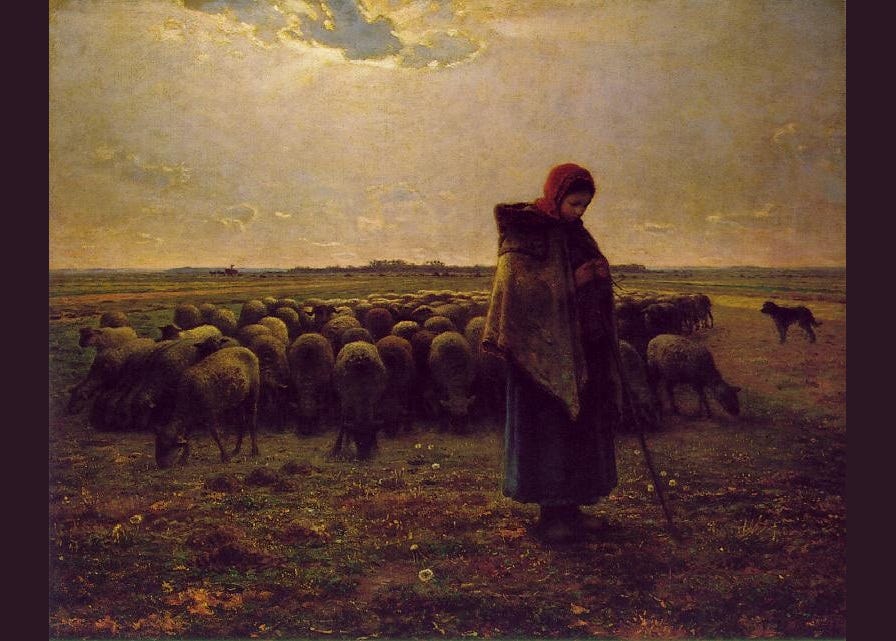
Other than that, aesthetically, realism is a means not an end.
Since the term has many and varied meanings, from politics to philosophy, I will define it for my purposes as stuff that makes the fictional settings, characters, and actions seem convincing and real. Nothing to do with the school that holds realism is the ordinary and the mundane, still less the muddy and dreary. Shepherdesses are not more realistic than princesses, merely more plentiful.
Now, if princesses are more plentiful than shepherdesses, or every shepherdess is secretly a princess, that needs a powerful and plausible explanation to be realistic. Even if your land is divided in so many kingdoms that there’s a king in every valley, most have enough subjects that such abject work as shepherding sheep -- exposing her to every blast of weather -- would be done by a servant.
Then, such lands tend to be violent, and sometimes the king’s daughters would flee when he was overthrown, to take what service they could get. A countryside may be filled with shepherdesses who claim to be the daughter, or granddaughter, or great-granddaughter of a deposed king.
Which underscores that this is a violent land, that the people are proud of descent, that they remember injuries a long time (even if they make them up). All of which can complicate your hero’s quest that passes through it.
Because the purpose of all realism is to enable aesthetic effects.
There is drama when your hero is in real danger, such as knowing that in every village, someone’s ready to take offense because he is, after all, royalty.
There is tragedy when your hero, having met a dozen shepherdesses, a score of gooseherds, and a hundred plowmen, all of whom claim royal blood, still treasures his own as making him special and so falls into disaster.
There is pathos when the shepherdess heroine is reluctant to marry the neighboring archer, because of her royal blood, despite knowing that the kingdom will never be reclaimed.
Even the happy ending, when a knight and his company try to carry off the shepherdess, and the archer leads his companions to her aid, and she accepts the archer as her heroic rescuer, turns on the way that this shepherdess seems a real woman who has really overcome her silly reluctance to her true love, and will really be happy with him.
Comedies, of course, have more than a touch of unreality about them. Still, there’s an entire range. At the extreme, a farce fractures realism with its wild coincidences driving the plot. But the more characters seem real, and their settings and plots seem real, the more the comedy is leavened with the drama, the pathos, and the happiness that require realism.
Some, of course, is the clutter that lends verisimilitude to the world. The thriving trade in wool leads to conflict between the rich and powerful merchants and the nobles who regard them as uppity. Or the company trudges through villages where women sit on the threshold and spin. Nothing may come of it except that there are people to whom the great quest is the backdrop to their relentless pressure to spin, so it can be woven, so it can be sewn up, so that there are clothes to wear, just as the relentless work is a backdrop to the quest.
Even there, the realism is not an end in itself. It is making the world seem larger and more complete, not just a stage setting for the quest. If the world is endangered by the Evil Overlord, it truly helps if there are people who live in it, and who would suffer for what he does. (This is why you do not want to endanger the world too quickly, before it is built up with these touches.1)
After all, the destruction of a stage-set is trivial.
The destruction of a world is grave, but it does need a world to be destroyed.
"Nothing to do with the school that holds realism is the ordinary and the mundane, still less the muddy and dreary."
Ugh. Yes. This, so much. I can still remember teachers who bombarded me with this in high school. Fantasy and SF were 'unrealistic' and thus inferior unless they concentrated on how hopeless everything was and how vile everyone was. Even as an affectated angsty teenager I knew that was nonsense.