
Removing The Problem
Curses and ghosts

How hard is it to remove a curse? Or, for that matter, to remove ghost haunting a castle?
This may be the root of your decision to make curses hard to break,1 and even hard to detect2 -- or, of course vice versa.
It may even affect the metaphysics of the world, for the ghost.3 If the religion holds that the clergy, or the pious, can exorcise ghosts or demonic infestations, whether it’s right may be a question, and the plot will dictate the very metaphysics of the setting.
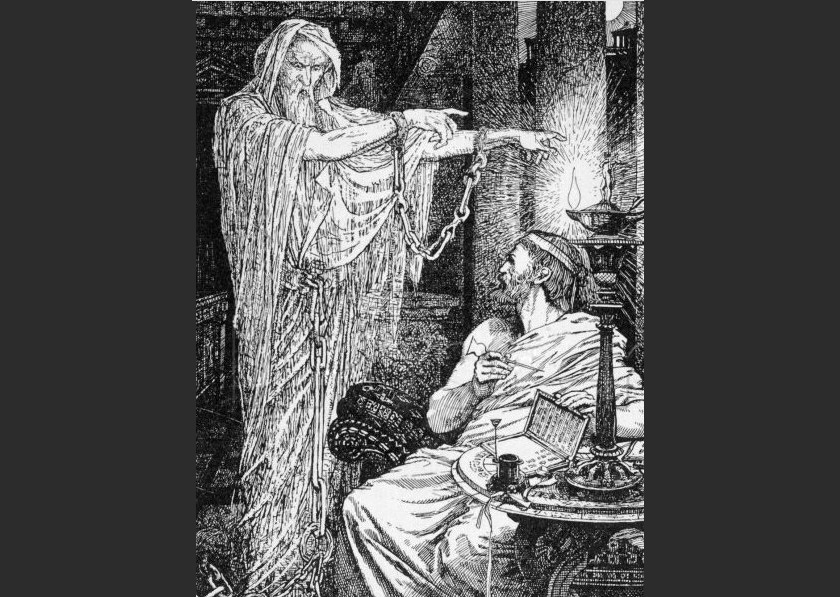
On the other hand, of course, the characters may be casually secular, and so the question of metaphysics doesn’t arise, or perhaps the religious friend can arrive as the cavalry to save the day.
Perhaps only a philosopher can exorcise a ghost, with his wisdom and his indifference to worldly things, or perhaps by being calm and measured, and so (at the time when less wise souls panic) observing the ghost and gleaning from the sight what binds the ghost to the place it haunts. (What is keeping it there is, of course, a metaphysical issue. If you must find the murdered body and bury it, that implies a great deal about funeral rites and their effect on the very soul.)
Or perhaps a ghost can be fought like any other creature.
But from your viewpoint -- as long as you haven’t painted yourself into a corner4 by earlier works in the series -- the question is how long it needs to take in order to serve the story. Everything else turns on that.
If the curse or ghost was the bait to draw the character to where the villain wants him, a way for them to establish their good faith to the strangers, or just an introduction to the characters, to start them in action, it can and should be dealt with briefly to get on with the story, having established the characters and all the rest.
If the curse or ghost is the central problem and conflict of the story, it must be hard to deal with. How hard determines the length of the story; a novel needs more conflict, and more complex conflict, than a short story.
Whether the conflict is working out what to do, or actually doing it, is also a major factor.
I note it takes a deft hand to make discovering what to do difficult, and then actually doing it also difficult, since they are, in effect, two different conflicts. Though it does give your story a sharp swerve, which helps give it shape, you do have to have a story long enough to bear the weight.
A deft hand can also, sometimes, in a series, escape having painted itself into a corner. Discover the differences in nature in this story from the last one where something like this happened.
Perhaps the priest can easily dispel ghosts as such, but this ghost is a wizard, and what looks like ordinary haunting is in fact magical workings. These workings, not being directly powered by the ghost, are not so easy to dispel, and the ghost can not be easily reached through them.
Perhaps a magical object drives the curse, not just laid on the stones of the castle, and until you dig out the object and destroy it, the curse can not be laid. (And perhaps it was put under the cornerstone, so that removing it will destroy the castle. Some things come at a price.)
Or, if the ghost requires a funeral for its body to be laid, perhaps the body is harder to retrieve. Or else there are specific requirements for the funeral that will require deciphering the objects found with the bones so that you know who to call upon.
The great trick is avoiding making the precise level of difficulty look like a plot device. Especially because it is one.
Foreshadow with care. If it’s in a series, remember that while earlier installments may paint you into a corner, they make bad foreshadowing because you do not know whether the readers have read them.
Character reactions are also important. Grumbles about how the better they get, the harder the cases that are assigned to them. Raucous betting pools about what the problem will be this time. Arguments about whether applying the basic removal is the best way to test whether this is a simple case.
Then, since the question is central, just about every element of the story can be artfully aimed to support the matter, which helps. Even the elements that are used to conceal the matter are part of supporting it.
Which is just the gentle art of writing, in one form it takes.
One thought concerning the metaphysics of the story universe is What Is A Ghost?
Is a ghost a Spirit Of The Dead? Is a ghost the emotional "overlay" of a violent death or violent event (not an actual spirit of the dead)?
Of course, the metaphysics might allow for several explanations for a "haunting".