
The Chosen One
Can this trope work?

I mentioned, a while back, that the Chosen One trope can make a high fantasy have problems like a portal fantasy.1
But that’s not the big problem with the Chosen One.
The big problem with the Chosen One trope is whether you introduced anyone to Choose him.
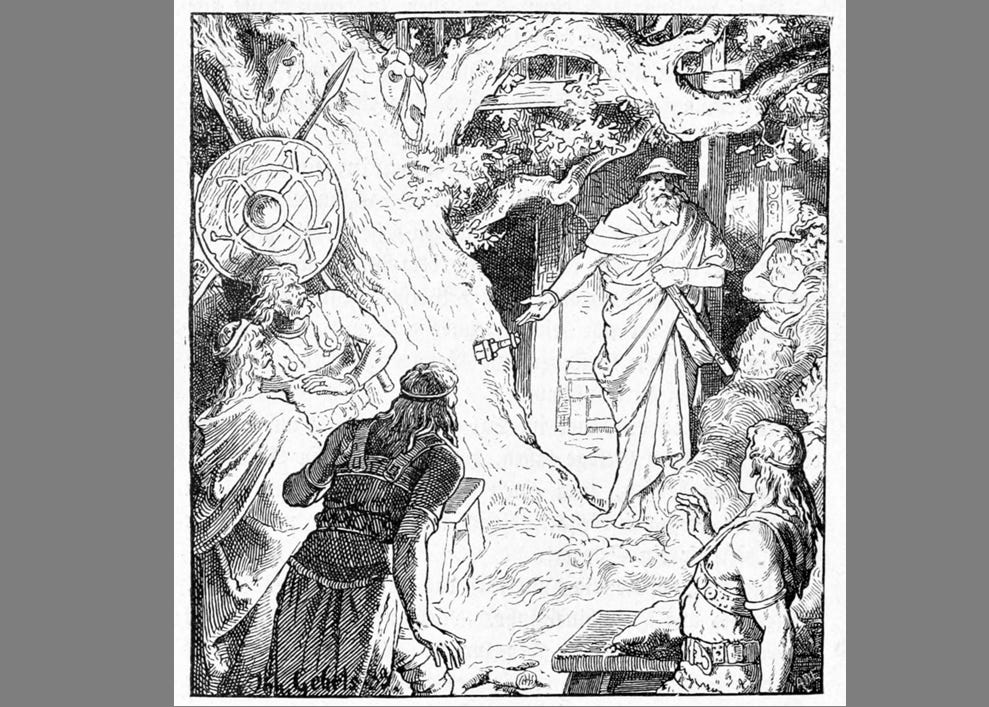
Who is this person? What is his character? What are his motives in choosing someone? Did he set up the situation to require a Chosen One, and if so, why? How wisely would he go about it? Is he even human? Or a rational being equivalent to human?2
The missing parts are a sign of a plot device plopped in the middle of the story, where they are hard to miss. And this one is generally used as a way of evading the hard work of writing.
Why is this character the main character? He’s the Chosen One?
Why is he pursuing the Evil Overlord? He’s the Chosen One?
What drives him to risk his life without reward? He’s the Chosen One?
Why does everyone support him? He’s the Chosen One?
I read a fantasy once in which a wizard had, long ago, described who was needed to do something, the main character had been deliberately set up to fit the conditions (shoved into a body of water, for instance), and a wizard in his day asked him (after he survived doing it) to consider his fate as the chosen instrument. He cheerfully explained that the long-ago wizard would have considered such things, foreseeing them in his crystal ball, and set up the conditions such that they would set up the right person anyway.
This is better than most, but it doesn’t lean into the issue the way it should. Why did the wizard chose this one? What made him suited more than anyone else? Why does he blandly accept this fate?
Even having him be affected by the thing that he did would have worked better. Perhaps he passed through a liminal region with all that implies. Though it would not answer all the questions, it would clear up some.
Harry Potter being called “The Chosen One” is not so bad because it’s clear that someone just dreamed it up. Still, it would be better if someone actually pointed out that calling him that without the idea of who chose him is silly.
This is one of the chief uses of that hoary cliche, the prophecy. The problem is that many people use the prophecy without remembering that it is inspired speech. Who inspired it? With what motives? For what purpose? That’s the Chooser of the One.
The more the Chooser of the One stays off stage, the more important it is to depict the Choice as wise. If Odin shows up at a wedding, drives a sword into a tree, and tells everyone that the man who pulls it out gets it -- well, it’s Odin. He’s probably out to cause trouble and war. He’s not known as the Necromancer for nothing.
If the age-old sword was destined for the hand of the farm boy, and he defeats the dragon, the old warriors who guarded him on the way can give him a side eye and ask about his fighting style, only to learn that the sword guided him in it, and his lack of knowledge was the only thing that let him not fight against its ancient teachings -- perhaps not so good as modern for battles, but much wiser for dragons -- and thus was the wisdom of the sword’s forger revealed.
If at the last moment, the young farmer’s lad realizes that all his companions had axes to grind in the civil war, and that he must act without consulting them because he alone just wants the war to end, so that he uses the mysterious Celestial Pearl -- the celestial wisdom behind choosing him is revealed.
Such are the complications.
I "asked" the person who chose my Chosen One why he made that choice, and the cold bastard said, "We needed someone who had enough talent to do it without much training, and no connections to protect him; someone we hadn't invested in, because we were pretty sure we'd end up having to kill him, and that would be wasteful."
I think by the point in the WIP that I've reached, the Chosen One knows this; and it will flavor his reaction to Cold Bastard suddenly being in need of rescue.... (He will do it anyway, because he's that kind of person. But he may take the opportunity to try to extort something while he's got Cold Bastard over the barrel, and I can't blame him.)
I wonder if the lack of specificity in the identity of the Choser is an ambivalence towards divine authority in many a modern mindset. Safer to leave it obscure and let the reader decide whether God is real or not.