
Where Do We Go From Here?
In the middle

When you are telling a story, you are wise to follow Mark Twain’s dictum
A tale shall accomplish something and arrive somewhere.
A finer point in that, in the middle of the tale, your reader should have some notion of what constitutes an accomplishment and a destination.
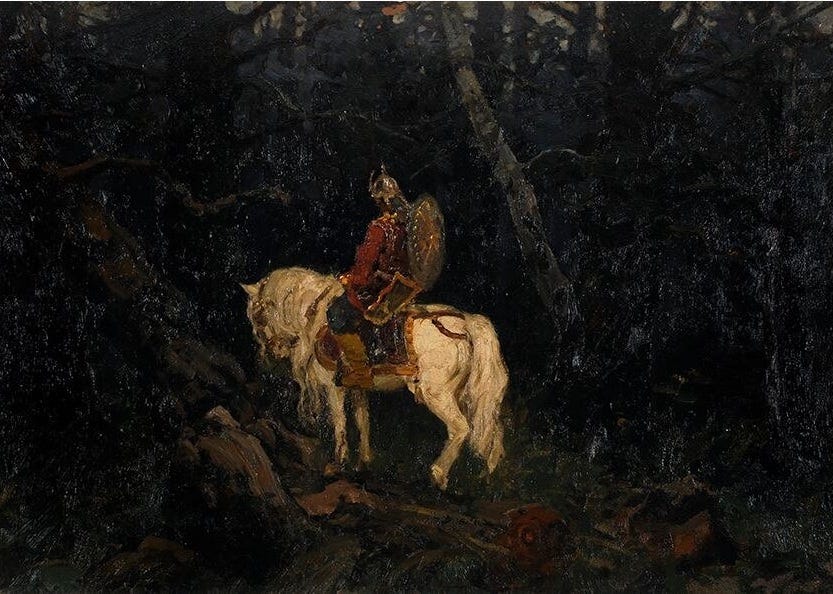
A character standing by a crossroads with no signs and a dozen different roads leading off is frustrating. A character where we don’t know which destination he wants to end up leaves us with no forward motion.
Even a character whose reaction to what he envisions being in ten years is to complain that he’s just trying to get to Friday should give the idea whether he’d be happy in any secure job that lets him hang out with his friends and not worry about money too much, or only in a high-status job with high wages.
Or, for that matter, whether he wants to escape the monster-ridden borderland with a nest egg, or would be happy with just some enchanted armor and weaponry to make the fighting so much easier and more profitable.
No amount of heaping up of adventures compensates for the awareness that it means nothing -- though, of course, it is better than a slow portrayal of ordinary life without even the compensation of excitement to mitigate the awareness that it means nothing.
Episodic adventures do not have this problem. Provided that each one has a beginning, a middle, and an ending, each adventure has its own meaning. Even slice-of-life stories can have their own little episodes. Comics may make each comic strip its own unified things.
True, if the tales are dramatic, not slice-of-life, you do have to juggle why he keeps on adventuring.1
I have read a story about a heroine dropped into an isekai fantasy world, where she ended up fighting by the hero, and I was wondering what the end game was.
Neither one showed any signs of wanting to adventure forever. While there was an arguable way to end their battles, neither one showed any indication of thinking that if they just got rid of the central problem, they could happily settle down. Or found an adventurers’ school. Or keep on hunting monsters after they dealt with the big one. So where was it going to go?
A character could, of course, fool himself, but in that case, the story has to foreshadow that, so we can see either the unhappy ending where he gets what he doesn’t really want, or the happy ending where he works through that and gets the ending he does really want.
No matter how surprising the actual destination is, it has to fit in with hindsight.
If there is no real destination, if the hero has only a nominal goal -- one that is transparently a means to move the character about so that he can have more episodic adventures -- that may in fact hit problems in that the readers may want to see progress toward this goal and be frustrated at how it never appears closer.
A string of adventures that do have an actual goal needs to show progress at points. Furthermore, it has to feel like real progress. If the hero overcomes a string of obstacles, we have to see his goal approaching. And other characters should react as if something real was happening.
One handy way to ratchet up the tension is to have the mounting success draw more and more attention from the villains, for instance, which also has the handy effect that the readers realize that the more the villains react, the more clearly the hero poses a real danger to them.
The real problem appears when you land the hero in an intentional tangle. In Byzantine court politics, with a love tangle complicating the issues, with mysterious magical spells or objects moving about, whom can the hero trust? How will all these machinations turn out?
Or, obviously, a mystery. All these clues and red herrings? Do they add up at all? As the detective and any associates pile them up do they merely lead to bafflement?
This is one reason why red herrings are often dramatically cleared up. Rhetorically, it is wise to frame it as dashing the detective’s hopes, but it still offers a glimpse of light in the gloom.
Then, mysteries have an innate advantage in that everyone knows what the end game is: deduce who the murderer is, and reveal it. Or conclude it should be concealed, sometimes.
In the Byzantine court politics, there frequently is a question of what the main character wants, even before the question of whether any faction would give him it, and if so, for what.
This can land the character in a maze where the reader has no notion whether the character’s actions are for good or for ill. It drains tension while draining the work of significance.
It can be a difficult thing to juggle, but you need to keep up the reader’s interest by giving him something to latch onto.